
Half Pigeon Pose: A Teacher's Guide to Anatomy, Range of Motion, and Intelligent Sequencing
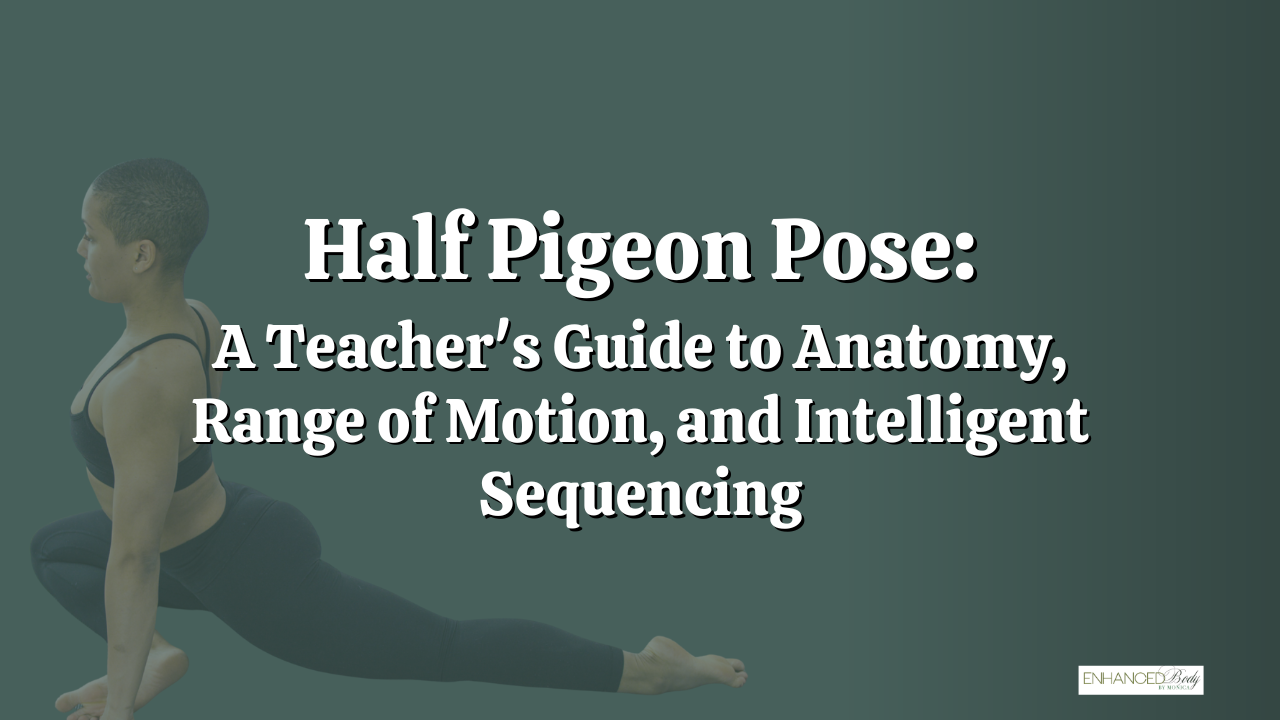
Half Pigeon Pose: A Teacher's Guide to Anatomy, Range of Motion, and Intelligent Sequencing
If you teach vinyasa or flow classes, there's a good chance Half Pigeon has become a go-to asana in your sequencing, and it was in mine for years too. It feels like the standard way to close class, students seem to expect it, and it has become so embedded in contemporary yoga that leaving it out almost feels like forgetting something essential.
I want to push back on these beliefs, and ask you: are you including Half Pigeon because it genuinely serves the students in your classes, or because it's what you were taught to include in your sequence?
Half Pigeon (Eka Pada Rajakapotasana) requires a very specific combination of hip mobility that a significant portion of your students may simply not have access to. When we ask students to practice a pose their anatomy doesn't support, we're not helping them get more open or more flexible. We're asking their bodies to find a workaround, and those workarounds often create the exact problems we're trying to address.
This is one of those topics that fundamentally changed the way I teach. As I continue to study anatomy, biomechanics, and injury mechanics, over time I've developed a much more nuanced relationship with this pose than I had in my early teaching years, and I want to share what I've learned with you.
UNDERSTANDING THE ANATOMY
To understand why Half Pigeon works beautifully for some students and creates pain or a sensation of compression for others, let’s start with the anatomy of the hip.
The hip is a ball-and-socket joint where the head of the femur (the thigh bone) articulates with the acetabulum, which is the cup-shaped socket in the pelvis. This structure allows for movement in multiple planes: flexion and extension, abduction and adduction, and internal and external rotation. What makes the hip so interesting, and so variable from person to person, is that the specific shape of both the ball and the socket differs significantly between individuals, and those differences matter enormously in a pose like Half Pigeon.
In Half Pigeon, the front leg requires three movements to occur simultaneously: hip flexion, hip abduction, and external rotation of the hip. The back leg requires hip extension with some degree of internal rotation. This combination places specific and considerable demands on the structures of the hip joint, and understanding those structures is foundational to sequencing this pose intelligently.
The hip joint capsule is a fibrous tissue that surrounds the joint and provides stability while allowing movement. Its elasticity varies between students, which is one reason why two people with similar muscle flexibility can have very different available ranges of motion in this position. Surrounding the capsule are several ligaments (the iliofemoral, pubofemoral, and ischiofemoral ligaments) that limit excessive hip motion, and their length varies significantly between individuals.
The deep hip external rotators are a group of six small muscles responsible for controlling hip rotation: the piriformis, superior and inferior gemellus, obturator internus and externus, and quadratus femoris. For the front leg in Half Pigeon, these muscles need to lengthen considerably. The gluteal muscles (gluteus maximus, medius, and minimus) experience varying degrees of lengthening depending on how the student is positioned in the pose.
And then there's skeletal structure, which is critical for teachers to understand. The shape of the femoral head, the depth and angle of the acetabulum, and the angle of the femoral neck all vary between your students. These are structural differences that cannot be changed through stretching, consistent practice, or any amount of time on the mat, and they have a direct impact on what is available in Half Pigeon for any given student.
RANGE OF MOTION REQUIREMENTS FOR HALF PIGEON
Half Pigeon has a specific range of motion requirements that we need to understand before we can sequence it intelligently.
For the front leg, the pose requires approximately 90 to 110 degrees of hip flexion depending on how upright the torso is. It also requires significant hip external rotation, typically somewhere between 45 and 60 degrees or more depending on how parallel the shin is to the front of the mat, as well as moderate hip abduction as the leg moves away from midline. These three movements happen simultaneously, and that matters because the available range in each direction is affected by what is happening in the other directions. A student who has 50 degrees of external rotation with the hip in a neutral position may have considerably less when the hip is also flexed and abducted.
For the back leg, the pose requires hip extension with the leg positioned behind the body and some degree of internal rotation. Students with limited hip extension or restricted hip flexors often compensate by tilting the pelvis, which shifts the demand into the lower back rather than addressing the intended tissues.
The degree of each movement varies depending on how the pose is set up, and that variation is appropriate and expected. A front shin positioned more parallel to the top of the mat requires more hip external rotation. A shin angled back toward the back hip requires less hip external rotation. Both are legitimate expressions of this pose. Students whose hip anatomy supports limited external rotation can absolutely access a version of Half Pigeon, and what they need is explicit permission from you to find the position that suits their body rather than matching an aesthetic you've demonstrated in class.
WHAT PROHIBITS STUDENTS FROM PRACTICING HALF PIGEON
Not every student can practice Half Pigeon the way we've traditionally been taught to teach it, and understanding why is one of the most valuable things you can offer your students. The factors that limit access to this pose fall into two broad categories: skeletal variation and soft tissue restriction. It's worth knowing the difference because they respond very differently, and treating one like the other creates problems.
Skeletal Variation
Skeletal variation is the most important piece for teachers to understand. The depth and angle of the acetabulum varies significantly from person to person. Students with deeper hip sockets have more stability but less available range of motion. Students with shallower sockets tend toward more mobility but potentially less stability. A student with a deep socket may experience bony contact (the femoral head meeting the edge of the acetabulum) before they achieve the hip angles typically taught in this pose, and that has nothing to do with how much they practice or how willing they are to work into the position.
The angle at which the femoral neck meets the femoral shaft, called the angle of inclination, also varies between individuals and affects how much hip flexion, abduction, and rotation is available before bony structures make contact. Similarly, the degree to which the hip socket faces forward (anteversion) or backward (retroversion) directly affects rotational capacity. A student with significant acetabular retroversion will have limited hip external rotation regardless of how much soft tissue work they do, and continuing to push for more range will not change that.
These skeletal variations mean that for some students, the sensation they experience in Half Pigeon is bone meeting bone, a sensation of compression rather than muscle lengthening. No amount of breathing, releasing, or consistent practice will change their skeletal anatomy. Continued pressure into that position will create irritation, not progress.
Soft Tissue Restrictions
Soft tissue restrictions are a different category entirely. The joint capsule can have varying degrees of elasticity, and a capsular restriction can limit range of motion regardless of how flexible the surrounding muscles feel. Muscle and fascial length in the deep hip rotators, hip flexors, and glutes also affect what's available. The distinction that matters for teachers is between tissue that can adapt to new ranges over time with progressive loading and tissue that has already reached its available range based on structural anatomy. When you understand that difference, you can respond appropriately to what a student is telling you rather than applying a one-size approach.
Injury and Current Pathology
Students with a history of hip labral tears, femoral acetabular impingement (FAI), prior hip surgery, or hip replacement face additional considerations in this pose. Students currently experiencing hip impingement, knee pain, SI joint dysfunction, or piriformis syndrome each need you to have alternatives ready. These are not edge cases; they are the reality of the students who come to your classes.
HOW TO RECOGNIZE WHEN A STUDENT IS AT THEIR STRUCTURAL LIMIT
One of the most valuable skills you can develop as a teacher is the ability to distinguish between a student who needs time and progressive loading to adapt to a new range versus a student who is working against a structural limitation.
When a student describes the sensation as feeling compressed or as a deep pressure rather than a pulling or spreading feeling through the outer hip or glute, that's information worth taking seriously. When the discomfort is located deep in the groin or as a sensation of compression at the front of the hip joint, that pattern is more consistent with bony contact than muscle lengthening. A student who tells you their range in this position simply hasn't changed over months or years of consistent practice is likely at their structural end range rather than a soft tissue limit. And when a student shows significant asymmetry between right and left hips that doesn't match their other movement patterns, skeletal variation side to side is worth considering.
When a student tells you they are experiencing these sensations, the appropriate response is to modify or offer an alternative. Encouraging them to breathe through it, push past it, or try to release into the position is not the right call. These are not cues that apply to every sensation in every body, and distinguishing between them is exactly what separates knowledgeable teaching from simply guessing.
WHY HALF PIGEON DOESN'T NEED TO BE IN EVERY CLASS
Does every student need deep hip external rotator lengthening? Many of the students in your classes have adequate or even excessive hip mobility. For those students, adding more passive stretching without corresponding strengthening doesn't build capacity and can create instability over time. The premise that Half Pigeon is something every student needs in every class is worth revisiting, particularly now that you understand the anatomy involved.
There's also the question of whether Half Pigeon actually accomplishes what we think it does. The pose is frequently cued as a hip opener or glute stretch, but for students whose hip anatomy doesn't support the required angles, they aren't actually accessing the hip external rotators or glutes in any meaningful way. They may be creating stress at the knee, compensating through the lower back, or experiencing compression at the hip. The pose isn't doing what you think it's doing for that student.
Then there's the practical reality of class time. Half Pigeon takes three to five minutes per side when you include setup, hold, and transition. That's nearly ten minutes of a 60-minute class, and if a significant portion of your students are compensating their way through it rather than genuinely benefiting from it, that time could serve them better in a more accessible pose.
To be clear: the goal of this article isn't to remove this pose from your teaching entirely. The goal is to be intentional about when and why you include it, and to have enough anatomical literacy to know which of your students it genuinely serves.
SMARTER SEQUENCING ALTERNATIVES
The good news is that when Half Pigeon is currently serving specific purposes in your sequencing (hip external rotator lengthening, hip flexor work, glute engagement), there are alternatives that accomplish the same goals with far better accessibility for most students.
For Hip External Rotator Lengthening
Supine Figure Four, is often the most accessible option for hip external rotator lengthening. Students can control the intensity by adjusting how close or far the bottom foot is from the body, and critically, it doesn't load the knee joint the way Half Pigeon does. Students can also add subtle movement, such as small circles or gentle oscillation, to explore the hip range actively rather than forcing a static end position. Seated Figure Four accomplishes similar goals with the added benefit of allowing some students to feel the external rotators more clearly, and Low Lunge with Hip Circles offers students a way to explore rotation in multiple planes while also building control and awareness of the range they have.
For Hip Flexor Lengthening
A standard knee-down low lunge provides hip flexor lengthening for the back leg with considerably more stability and control than Half Pigeon. A supported bridge variation with one leg extended and the other thigh drawn in toward the chest is another option, giving students access to hip flexor length with the mat providing support.
For Glute Engagement and Strengthening
This is where I'd encourage you to think differently about the goal entirely. When Half Pigeon is being used partly to address the glutes, passive stretching is actually a less effective strategy than loading them. Bridge variations like single-leg bridge, bridge with abduction, and bridge marches build glute strength eccentrically and concentrically in ways passive stretching simply cannot. Locust pose variations strengthen the glutes and hip extensors while students maintain active control. Warrior III and other single-leg balance positions require glute activation for stability in a way that matters functionally.
When Students Do Have the Anatomy for Half Pigeon
For students whose hip anatomy genuinely supports this pose and who find it beneficial, offering it as one option rather than the default, and only option, gives them agency without excluding anyone. Teach the setup carefully, emphasizing that the position of the front shin varies based on individual hip structure. Include active variations alongside passive holds: having students press the front shin toward the floor, engage the inner thighs toward the midline, or hold with hands at heart center creates active engagement rather than passively hanging out in the pose. And consider whether a long passive hold is serving every student in the room, or whether shorter holds with movement in and out might serve more people more effectively.
TEACHING HALF PIGEON INTELLIGENTLY WHEN YOU DO INCLUDE IT
When Half Pigeon is appropriate for a particular class and a particular student population, these principles will help you teach it with more confidence and more specificity.
Begin by establishing context before students even set up. Explain that the position of the front shin varies based on hip structure, that a shin angled back toward the back hip is completely appropriate for many bodies, and that finding the right position for their anatomy is the goal, not matching the version you're demonstrating. This information influences student choice before anyone has moved into the pose.
Spend time helping students distinguish types of sensation. Muscle lengthening tends to feel like a spreading or pulling sensation through the outer hip or glute. A sensation of compression or pressure at the knee is a different signal entirely. Teaching students to recognize that difference equips them to make real-time decisions in your class and in every class they ever attend. That's body literacy, and it's a gift.
Always offer props. A blanket under the front hip to level the pelvis when one side has less external rotation than the other is not a modification for students who "can't do the pose." It's a tool that allows the pose to serve more students more safely, and framing it that way matters. A bolster under the torso for students who don't have the hip flexion to fold forward comfortably is the same category of tool.
And remember that a several-minute passive hold is not universally beneficial. Some students' nervous systems respond much better to shorter holds with active engagement or movement in and out of the position. Offering a range of approaches within the same pose honors the reality that different bodies and different nervous systems respond to different things.
MY TEACHING EVOLUTION WITH HALF PIGEON
For years, Half Pigeon was in nearly every class I taught. It was part of the flow class formula I'd inherited, and I didn't question it. I thought I was helping students open their hips. I thought the discomfort I observed was productive tension, the kind you work through on the way to greater mobility.
Then I started paying closer attention to students’ reactions in the pose, and I didn't like what I saw. Students were grimacing in ways that didn't look like productive effort. I watched students shift and compensate, their lower backs rounding, their front hips lifting off the mat, their faces communicating something that wasn't satisfaction. I had students tell me they experienced knee pain after class, and I started reflecting on what I was teaching and the mechanics of each pose in my sequences before I connected it to Half Pigeon. I felt troubled by that. I'd been teaching a pose I believed was helping, and for some of my students, it wasn't.
My continuing education in biomechanics and anatomy helped me understand what I had been observing. Skeletal variation isn't something we help students override through persistent stretching. Some students just don't have the hip architecture for the version of Half Pigeon I had been teaching, and no amount of consistent practice was going to change that. What I had interpreted as a student not working hard enough or not relaxing sufficiently was often a student bumping up against a structural reality that I didn't have the knowledge to recognize.
Now I teach Half Pigeon far less frequently in group classes. When I do include it, I also teach alternatives, with time spent helping students understand how to find the version that actually serves their body. The change in my students has been real: fewer reports of hip and knee discomfort after class, more students who feel able to make choices based on what they're actually experiencing, and more trust for me because they know I'm teaching them something rather than blindly teaching a sequence.
That shift came directly from deepening my knowledge of anatomy and injury mechanics, and it's a large part of why I'm committed to helping other teachers develop that same foundation.
If you're a yoga teacher wanting to go deeper on these topics, my 6-month Teaching Students with Injuries mentorship program provides comprehensive education in anatomy, pain science, injury mechanics, and intelligent sequencing for diverse student populations. Learn more: https://www.enhanced-body.com/teaching-students-w-injuries
SEQUENCING PHILOSOPHY FOR TEACHERS
Half Pigeon raises a larger question about how we make sequencing decisions. Are you sequencing based on what you understand, what the students in front of you actually need, and what a clear risk-benefit analysis supports? Or are you sequencing based on habit, expectation, or what you saw the teacher who trained you do?
Intelligent sequencing requires knowing your student population: their common movement patterns, restrictions, and goals. It requires understanding the purpose of each class, whether that's building strength, exploring range, addressing a specific function, or supporting recovery. It requires thinking clearly about how each pose is using the limited time you have with your students, and whether that time is being spent in ways that serve the most students most effectively.
It also requires accepting that individual variation isn't an exception to plan around. It is the reality of every class you teach. Your students don't all share the same hip architecture, the same movement history, or the same capacity. When sequencing accounts for that reality from the beginning rather than offering modifications as an afterthought, your class becomes more inclusive, more informed, and more effective for everyone in the room.
Half Pigeon is not a pose that should be avoided. It's a pose that deserves the same thoughtful consideration you'd bring to any movement with specific anatomical requirements: a clear understanding of who it serves, when it's appropriate, and what to offer when it isn't.
MOVING FORWARD
As yoga teachers, understanding the biomechanics of what we teach and respecting the anatomical diversity of our students is part of the job. Half Pigeon is a useful case study in how a pose can work beautifully for some bodies and create real problems for others, not because those students aren't trying, but because the pose requires anatomy they may not have.
Moving away from one-size-fits-all sequencing toward a genuine understanding of individual anatomy serves your students more effectively and makes you a more confident teacher. Your students don't need to practice every pose in every class; they need a teacher who understands what they're teaching, respects the need for pose variation, and makes decisions based on the actual students in the room.
ADDITIONAL RESOURCES
For yoga teachers wanting to go deeper on anatomy, sequencing, and working with diverse student populations:
Listen to episodes of my podcast, Essential Conversations for Yoga Teachers, where I discuss anatomy, injury prevention, and evidence-based teaching strategies: https://www.enhanced-body.com/podcast_essential_conversations_for_yoga_teachers
Explore my library of over 500 recorded classes that demonstrate intelligent sequencing for different body conditions and movement goals: https://www.enhanced-body.com/alliance-membership
Have you changed your approach to teaching Half Pigeon? What alternatives have you found most effective with your students? I'd love to hear about your experience in the comments.
If you're ready to go deeper on injury-informed teaching, the 6-month Teaching Students with Injuries mentorship is where that work happens. Teachers who complete this program leave with the anatomy knowledge, pain science framework, and practical sequencing skills to work confidently with any student who walks through their door. Learn more: https://www.enhanced-body.com/teaching-students-w-injuries
About the Author
Monica Bright is a yoga teacher and continuing education provider specializing in teaching yoga teachers how to work confidently with injured and pain-affected students. With over 2,000 hours of continuing education in biomechanics, human movement, pain science, and injury mechanics, she helps teachers move beyond formulaic sequencing to understand that anatomical literacy and individual variation are essential professional responsibilities for movement teachers.
Join my newsletter for teachers!
By joining my newsletter, you’ll get first info on course registrations, informational emails, and so much more!
You can unsubcribe at any time.


